
Show the product doing its job.
The racking wall uses kit-based geometry to explain what the shop sells. The rack planner relates wall width, height and rack family to capacity and equipment, with a route to shop or ask Mike.
A specialist showroom, real racking and a clearer way to plan a cellar. Brandcore’s next-generation Wine Hardware site turns the product range into a useful buying journey.
Wine Hardware brings together custom residential and commercial cellar planning, racking, cooling equipment and a family-run Walnut Creek showroom. The maintained WordPress site already carried that breadth. The new candidate puts it into a more deliberate sequence: understand the space, explore the equipment, see the work and bring Mike the right questions.
Captured October 24, 2026: maintained WordPress website versus prelaunch beta awaiting approval. Production cutover is not claimed.
01 / The visible work
Compare the actual websites. Choose a recorded phase, switch to the phone view, or open either capture at its original size.
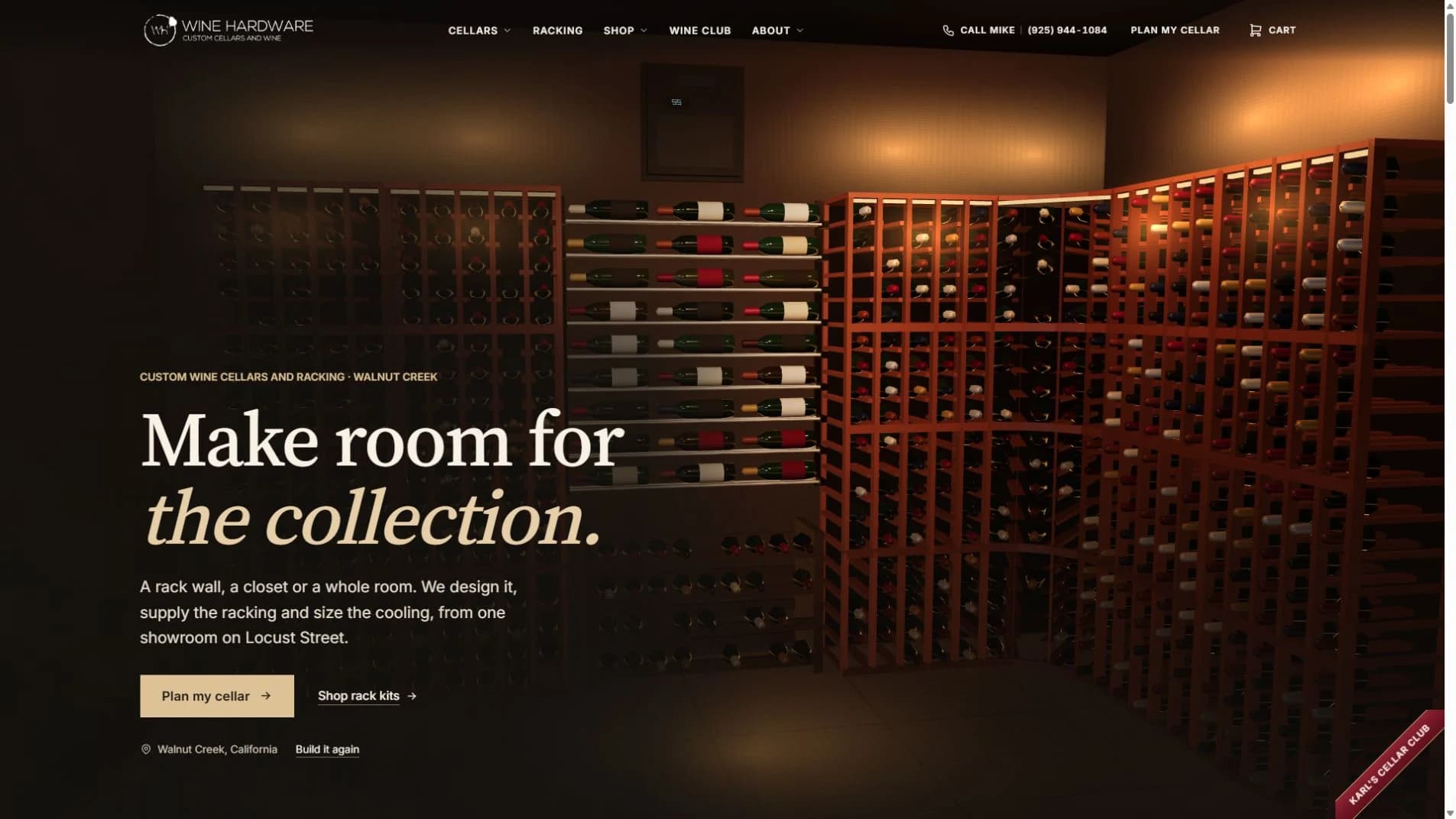
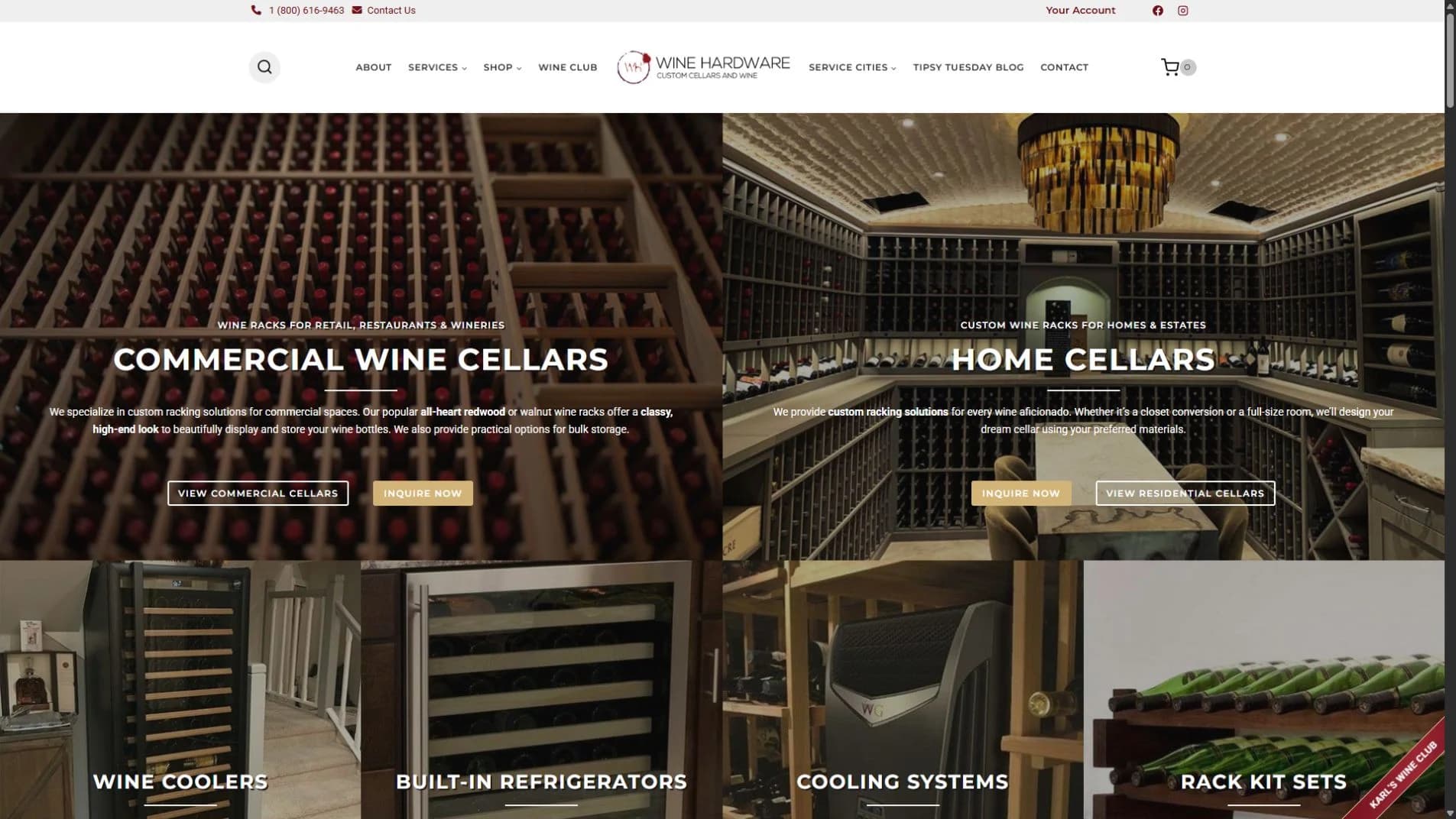
Drag anywhere across the image or use the slider. With the slider focused, use arrow keys, Home or End. Phone captures retain vertical page scrolling.
October 24, 2026 · Maintained WordPress site
The live WordPress homepage preserved at 16:42 UTC before the proposed cutover. This includes subsequent maintenance; it is not the original launch design. Desktop CSS viewport 1920×1080, phone 390×844, 1× device scale. Returned capture images are 1905×1072 and 375×812.
Open earlier capture ↗October 24, 2026 beta · Next.js launch candidate
The prelaunch winehardware.bcio.one homepage, with fonts loaded and the racking scene settled. Matching desktop and phone capture basis. The beta is a demonstrated capability, not an achieved production release.
Open later capture ↗The identity / Actual artwork
The recovered record includes an earlier green corkscrew lockup and the current burgundy wine-ring identity. The candidate retains the existing wordmark and artwork. Its contribution is the surrounding hierarchy, typography and product-led experience; this is not a claim that the candidate introduced a new logo.

Actual archived WHW_LOGO.png asset, final archive capture December 27, 2014. Earlier design attribution is not established by this recovery.

Retained original horizontal PNG. The 2021/03, 2023/04 and 2024/02 copies are byte-identical; upload-folder dates do not establish launch dates.

The retained rebuild SVG follows the supplied artwork. Decoded source artwork matches the retained current PNG; the company name and proportions remain recognisable.
The record / Observed website eras
The recovered source trail spans more than two decades and several storefront families. It adds context without pretending every archive is a complete working website.
235 indexed root-homepage records cover November 2003–June 2026. We recovered 91 usable website bodies; 143 replays failed and one verification interstitial is excluded. First observed captures below are not verified design launch dates or complete Brandcore attribution.
The earliest root-homepage source recovered here contains real product and navigation references. Missing original CSS and GIFs prevent a faithful visual replay. Earlier website coverage remains unknown.
Retained source references migration styles and ASP.NET storefront endpoints. This is an observed archive phase, not a verified launch date.
Custom header and product navigation are present in the retained source. Asset recovery is incomplete.
Divi, child-theme and commerce references establish a later WordPress phase. The actual green corkscrew mark was recovered separately.
The retained HTML identifies another theme generation. Its existence does not by itself establish Brandcore authorship.
OceanWP references remain evident in recovered source into early 2023. The snapshots bracket a period rather than provide a changeover date.
The retained Kadence family continues into the maintained site captured before cutover on October 24, 2026.
The beta demonstrates product-led racking, cooling guidance and configuration-aware inquiry paths. Production cutover and provider activation remain separate milestones.
02 / What we built
The racking wall uses kit-based geometry to explain what the shop sells. The rack planner relates wall width, height and rack family to capacity and equipment, with a route to shop or ask Mike.
The cooling sizer connects room dimensions and installation type to manufacturer-based guidance. The site makes the final fit check with Mike explicit instead of presenting a planning tool as an engineering approval.
Mike, Cari, the showroom, original project photography and retained 360 tours ground the website in the actual business. Supplied personal photographs retain their appearance.
Project configuration can accompany the inquiry into durable capture and staff CRM workflows. Assignment, stages, tasks and held follow-up drafts are documented capabilities. Email delivery and payment activation require their own rollout verification.
03 / Retained speed evidence
The candidate’s median mobile main-content paint fell from 7.269 to 1.660 seconds, with recorded transfer down from 1.228 to 0.319 MB. Its blocking time increased from 63.5 to 4,456.5 ms; the desktop performance score fell from 85 to 70. The paint gain and interaction cost both matter.
October 24, 2026 · 16:50–16:54 UTC · Homepage Lighthouse performance scores / 100
| Tested version | Mobile | Desktop | Mobile main-content paint (LCP) |
|---|---|---|---|
| Maintained WordPress homepage | 64 (64–77) | 85 (84–85) | 7.269 s (4.093–7.677) |
| Prelaunch Next.js candidate | 68 (68–70) | 70 (70–71) | 1.660 s (1.654–1.667) |
| Device / version | LCP | FCP | TBT | CLS | Transfer |
|---|---|---|---|---|---|
| Mobile · WordPressLCP range 4.093 s–7.677 s | 7.269 s | 3.768 s | 63.5 ms | 0.0053 | 1.228 MB |
| Mobile · CandidateLCP range 1.654 s–1.667 s | 1.660 s | 1.088 s | 4456.5 ms | 0.0043 | 0.319 MB |
| Desktop · WordPressLCP range 1.831 s–1.986 s | 1.920 s | 1.340 s | 0.0 ms | 0.0013 | 1.990 MB |
| Desktop · CandidateLCP range 0.373 s–0.381 s | 0.373 s | 0.300 s | 1138.0 ms | 0.0000 | 0.317 MB |
Twelve clean reports: Lighthouse 13.5.0 and HeadlessChrome 156 on the same Linux runner, three interleaved homepage runs per host and device. Standard simulated mobile/desktop presets, fresh isolated browser profiles and storage reset. Values are medians; ranges are retained in the selected speed record. Every run has before/after HTML identity receipts and request fingerprints.
04 / Explore the captured sites
Browse the locally preserved website versions. Each demo identifies its capture or reconstruction. Forms, ordering and account actions are disabled; these captures document a website state.
05 / The source trail
The visual comparison and selected lab record document the work at the stated dates. The complete original report and supporting files remain available through detailed review access.
Your next chapter
A website that explains the offer, helps a buyer make progress and gives the team useful context for the next conversation. Built around the business, then measured honestly.
Leave your details and we'll reach out within one business day.
Prefer the full form? Go to contact